Elephant-Trunk-Inspired Continuum Soft Robotic Manipulator
A six-segment, trunk-inspired soft arm that bends with tendons and changes stiffness and length with pneumatic silicone bladders. I led the structural analysis and validation of those bladders: the hyperelastic FEA that predicted their failure point, and the leak and burst testing that set the safe pressure envelope the team's bending campaign ran inside.
Role: Hyperelastic FEA, bladder testing & experimental design
Organization: Carnegie Mellon University (Pittsburgh, PA)
Timeline: Jan 2026 – May 2026
· ANSYS · Mooney-Rivlin FEA · Ecoflex Silicone Casting · Mechanical Testing
The full six-module arm bending and elongating under tendon and pneumatic actuation.
What I Built
Led the hyperelastic FEA of the Ecoflex bladders in ANSYS with a Mooney-Rivlin material model to capture the silicone's nonlinear behavior. I ramped internal pressure until the solver diverged and used that as the failure indicator, refining the mesh at the high-stress collar and corner regions to get a stable result.
Cast and fabricated the two-part silicone bladders with the fabrication team, and moved the Ecoflex mix off the standard 1:1 to a softer 1:2 A:B ratio to get more flexible, elastic modules.
Ran burst-pressure testing to failure across multiple bladder batches and took part in the water-immersion leak tests. The defects this surfaced, like sharp mold edges and sealing weak points, fed the next mold revision, which added fillets.
Contributed to the experimental plan and project documentation.
Results
The FEA gave a stable deformation ceiling near 5.07 mm before solver divergence, a usable design limit available before any bladder was cast.
Bladders ruptured at 15.6–16.2 psi in burst testing, which set the safe operating envelope; the assembled arm then ran well below it.
The finished bladders delivered the pneumatic axial-elongation mode, and the arm reached all four commanded extension targets. Combined with tendon-driven bending, the assembled arm demonstrated the dual actuation the design set out to achieve, across a 45-trial campaign.
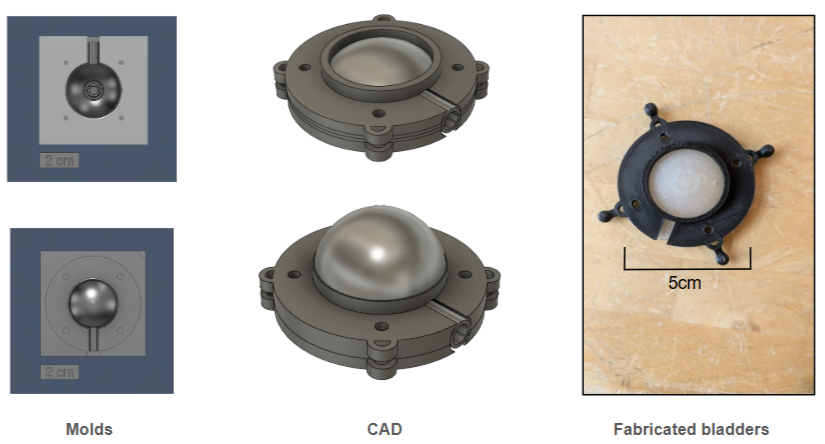
A cast Ecoflex bladder. Producing repeatable, leak-free bladders was the project's main fabrication bottleneck.
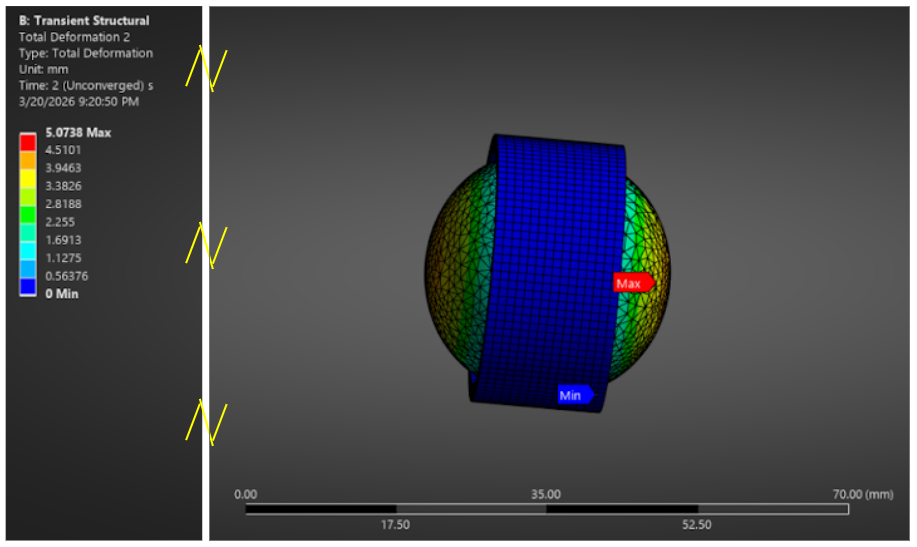
Hyperelastic (Mooney-Rivlin) FEA of an Ecoflex bladder. Pressure was ramped until the solver diverged; the last stable result set the deformation ceiling used as the design limit.
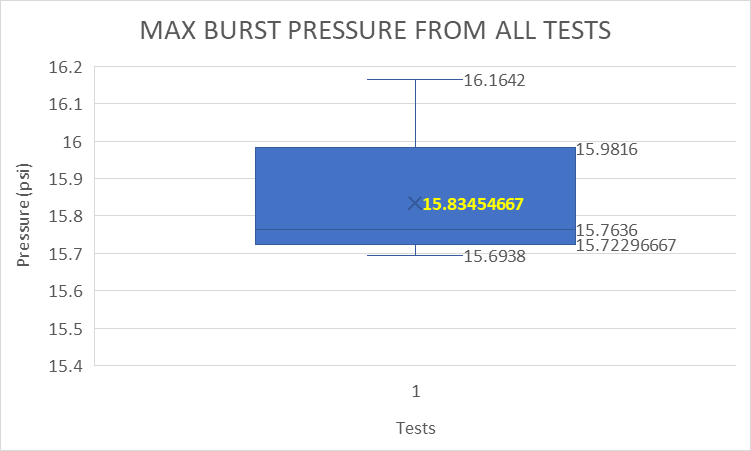
Burst-pressure testing across five bladder batches. Bladders ruptured at a median near 15.8 psi, which set the safe operating envelope.
System Overview
An elephant trunk is both dexterous and strong, which is hard to get in one soft arm. Most continuum manipulators commit to a single actuation route: tendons for directional bending, or pneumatics for elongation. This project combined the two so tendons handle bending direction while pneumatic bladders handle stiffness and axial elongation, which is closer to how a real trunk works. It was a five-person course project; my scope was the pneumatic bladders and their FEA, fabrication, and physical validation. Controls, firmware, simulation, and the trial protocol were owned by teammates.
Key Technical Decisions
Mooney-Rivlin over a linear-elastic model. Silicone at large strain is hyperelastic, so a linear model would have badly mispredicted both deformation and the failure point. Ramping to solver divergence gave a physically meaningful failure ceiling instead of a guessed one.
Destructive burst testing over trusting the FEA alone. The simulation gave a prediction; testing real bladders to rupture gave the true safe limit and surfaced casting defects the FEA couldn't see, which then drove the mold revisions.
Learnings & Limitations
Moving Ecoflex off its 1:1 spec to a softer 1:2 mix made the bladders more flexible but trades away cure strength, so flexibility and burst limit had to be balanced.
Bladder yield was the project's bottleneck. Casting repeatable, leak-free silicone parts was harder than the analysis suggested and forced several mold iterations.
A single bladder's bench burst pressure doesn't transfer directly to the assembled arm, where the collars and tendons restrict expansion, so the envelope is conservative.