Who I Am
I'm Harshit Jain, a robotics master's student at Carnegie Mellon focused on perception and simulation for manipulation. I build the parts that let a robot understand a scene and act on it: perception pipelines, physics-accurate simulation, and the vision models that connect them. My work sits where computer vision, robot learning, and real hardware meet.
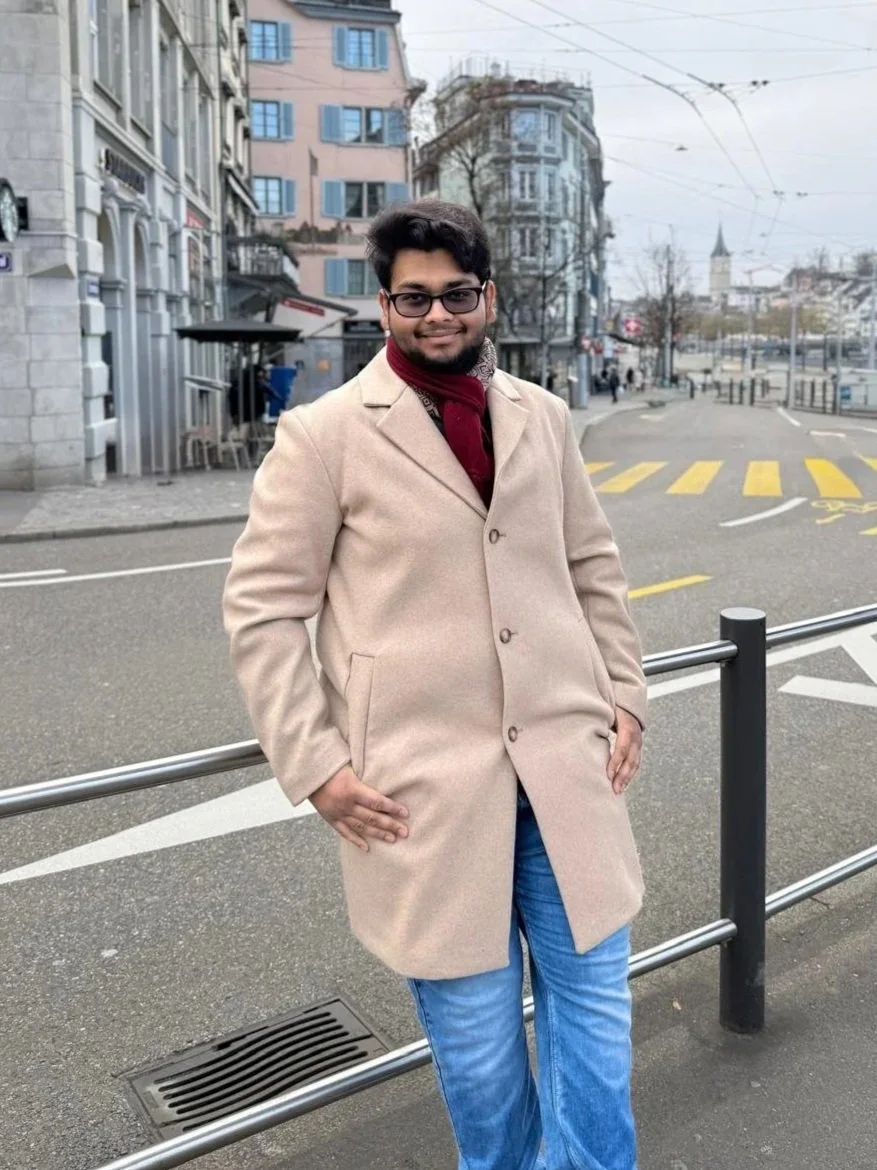
My Background
I earned my B.Tech in Mechanical Engineering with an AI and ML specialization from SRM Institute of Science and Technology, India. That mix set the pattern I've followed since: mechanical design on one side, perception and learning on the other, and a pull toward the point where they connect.
During undergrad I went past coursework into building real systems. I self-designed a 6-DOF robotic arm for autonomous EV charging, sizing every joint through torque and FEA analysis and training the vision model that detects charging ports across seven connector standards. That work became a Q1 journal paper and a filed patent.
That pull toward applied robotics took me to Umeå University, Sweden, on an ABB-sponsored autonomous-mining project. On a ten-person team, I owned one of two 6-DoF pose-estimation pipelines, combining instance segmentation with point-cloud regression to locate rock bolts to 0.055 m for robotic removal.
What I'm Working On Now
At Carnegie Mellon, I've gone deep on perception and simulation. At CERLAB, I built a physics-accurate Isaac Sim digital twin of a multi-component cardiac-defibrillator unit that generates realistic, physically valid tangles to train robotic untangling, working hands-on with Isaac Sim, OpenUSD, and PhysX.
I was also the sole owner of the camera-perception stack on CMU's first NASA Lunabotics rover, feeding live obstacle maps to Nav2 during competition.
From here, I'm moving toward learning-based manipulation and embodied AI.
What Drives Me
The moment perception becomes action: a robot reading a scene and doing something useful with it. I'd rather build systems that hold up in the real world than ones that only work in a demo, and I think the fastest path there runs through simulation, where a robot can practice thousands of times before it touches hardware.
Where I'm Headed
Toward learning-based manipulation and embodied AI, building perception and simulation systems that make it from research into real deployment. That's the direction robotics is moving as robots take on less structured, more general tasks, and it's where I want to do my work.
Beyond Engineering
Outside the lab, I travel, shoot photography, and play badminton. Three weeks across ten European countries taught me more about adaptability than any classroom could, and photography keeps me noticing small details, which turns out to matter more in engineering than I expected.